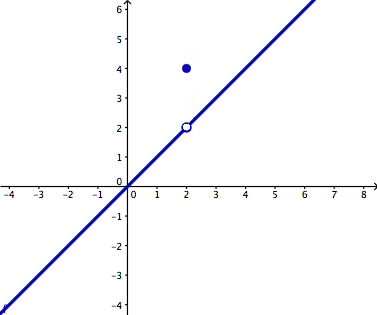
Discontinuity consists of two families: Removable discontinuities and Non-Removable discontinuities. They are separated into two families because the non-removable does not have existing limits, while the removable does. The removable discontinuity has one possibility: point discontinuity.
 |
| http://dj1hlxw0wr920.cloudfront.net/userfiles/wyzfiles/4a69dec7-03e0-492f-ac16-4dcd555579c9.gif |
This point discontinuity has a hole but there is no value at the hole. The value exists only if there is a closed circle above or below it.
The Non-Removable discontinuities consists of 3 types of discontinuities.
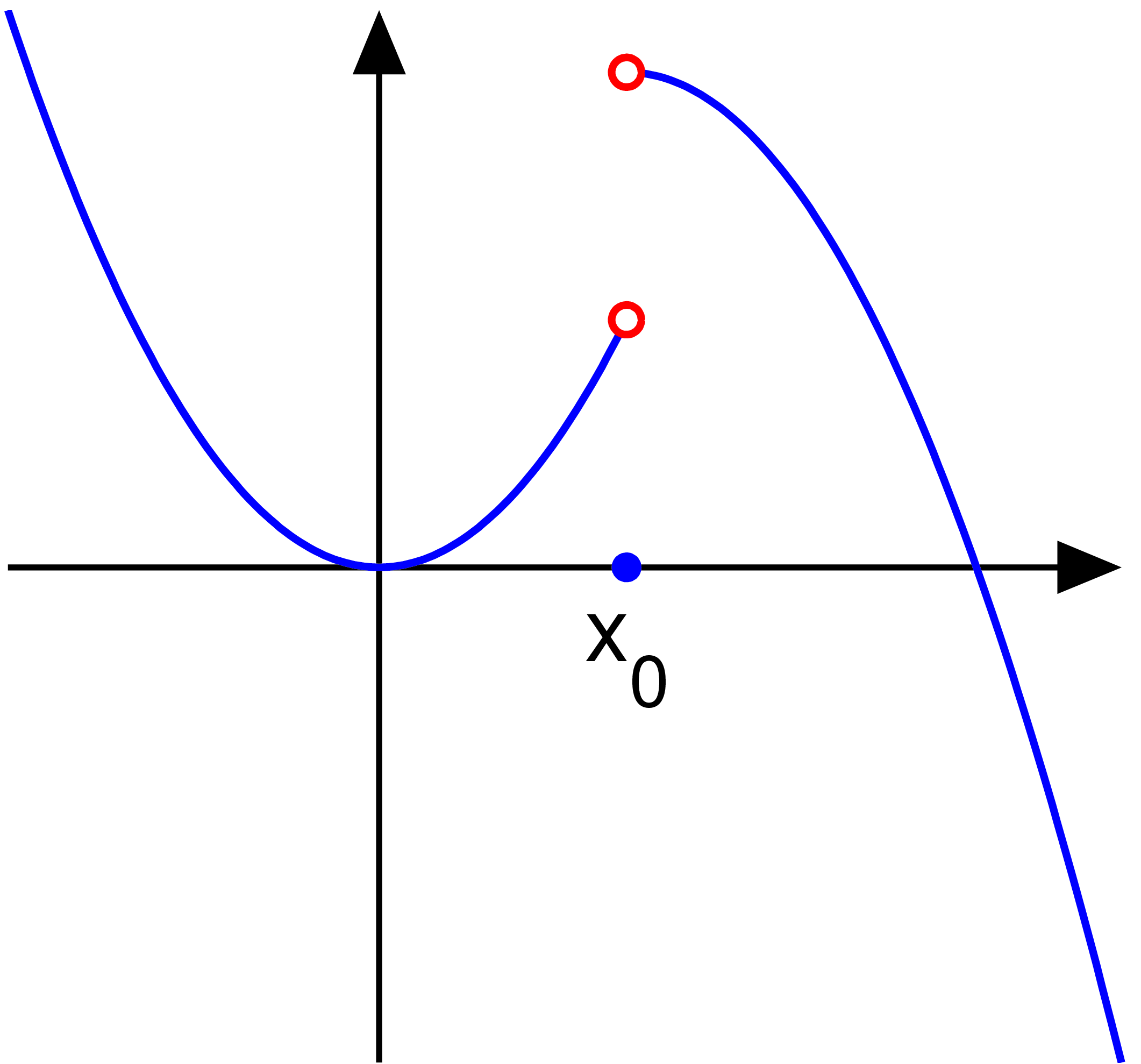
A) Jump Discontinuity
This means that they have different intended height from Left/Right when they are trying to reach the limit. This jump discontinuity has a limit that DOES NOT EXIST because it has a different intended height L/R.
 |
| http://upload.wikimedia.org/wikipedia/commons/e/e6/Discontinuity_jump.eps.png |
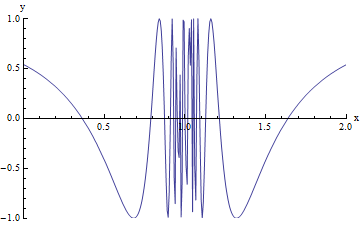
B)Oscillating Behavior
Another Non-Removable discontinuity, this can be described as a wiggly graph. This graph has a limit that DOES NOT EXIST because there is never a value or an intended height that is actually reached within the graph.
 |
| http://www.cwladis.com/math301/lecture%20images/infiniteoscillationdiscontinuityat1.gif |
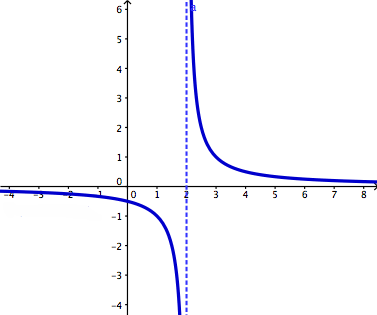
C)Unbounded/Infinite Discontinuity
We say it is unbounded because infinity is not a value that the graph ever reaches. There is usually a vertical asymptote which causes the unbounded behavior. The limit DOES NOT EXIST at unbounded/infinite graphs.
 |
| http://dj1hlxw0wr920.cloudfront.net/userfiles/wyzfiles/44bad38c-431e-4382-8fe9-86303561b2a0.gif |
2. A limit is the intended height of a function. A limit exists when you have a continuous graph which means the value of the function is the same as the limit. A limit does not exist when the Non-Removable discontinuities and their restrictions appear on the graph. A limit is the intended height, whilst the value is the actual height (y-value).
3.We evaluate limits numerically by: evaluating it on a table. This means we take the number of 'asx--># and evaluate it on the graph from the left and right. We plug it in to the calculator and find the values that are closest to that # to find the actual value of the limit.
 |
| https://finitemathematics.wikispaces.hcpss.org/file/view/limit_table.PNG/239144381/575x194/limit_table.PNG |
We evaluate limits graphically by: Observing the jumps, holes, values, continuities, breaks, and discontinuities. We observe where there are different restricitions and this determines whether the graph is continuous or discontinuous. We use there observations to find the value if there is a value and the limits if it is continuous.
 |
| http://curvebank.calstatela.edu/limit/imitscan.gif |
We evaluate limits algebraically by: using 3 methods:
a)Direct Substitution- You take the # in the 'x->#' and plug it in directly into the function. You can get a numerical answer such as 0/#, #/0, and these are both possible answers. However, if you get 0/0 it is indeterminate form which means the answer is not yet determine and you have to use an alternative method.
b)Dividing/Factoring: Since direct substitution met a restriction when you got 0/0 (only use alternative methods when you get 0/0 from direct substitution) then you can factor both the numerator and denominator to cancel out common terms. This will remover the zero in the denominator. After you have canceled the terms, you plug in the 'x->' like in direct substitution to get your answer.

No comments:
Post a Comment