Pages

Thursday, June 5, 2014

BQ#7: Unit V Difference Quotient

The difference quotient is used to find the line of a tangent graph.  We see a secant line when the curve is touched by a secant line on two points. In contrast, the tangent line only touches the curve at one particular point. A tangent line can be horizontal along the curve. The different points on the curve have different values these values are not numerical but they are substituted by [x+h, f(x+h)], [x, f(x))], and these are the coordinates which allow us to derive the difference quotient. We can say delta x instead of h because it basically means the same thing. It just depends on the units you are using to solve for the graph.


http://cis.stvincent.edu/carlsond/ma109/DifferenceQuotient_images/IMG0470.JPG
http://sites.csn.edu/istewart/mathweb/math126/diff_quotient/images/fun5_d2.GIF


Monday, May 19, 2014

BQ#6: Unit U Concepts 1-8

1. Continuity is a predictable graph that goes where you think it should. These graphs have no breaks, holes, or jumps. You can draw continuity graphs without lifting your pencil because they are, continuous. The value and the limit are the same.
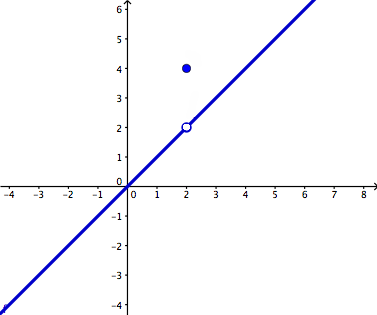
Discontinuity consists of two families: Removable discontinuities and Non-Removable discontinuities. They are separated into two families because the non-removable does not have existing limits, while the removable does. The removable discontinuity has one possibility: point discontinuity.
http://dj1hlxw0wr920.cloudfront.net/userfiles/wyzfiles/4a69dec7-03e0-492f-ac16-4dcd555579c9.gif

This point discontinuity has a hole but there is no value at the hole. The value exists only if there is a closed circle above or below it.

The Non-Removable discontinuities consists of 3 types of discontinuities.
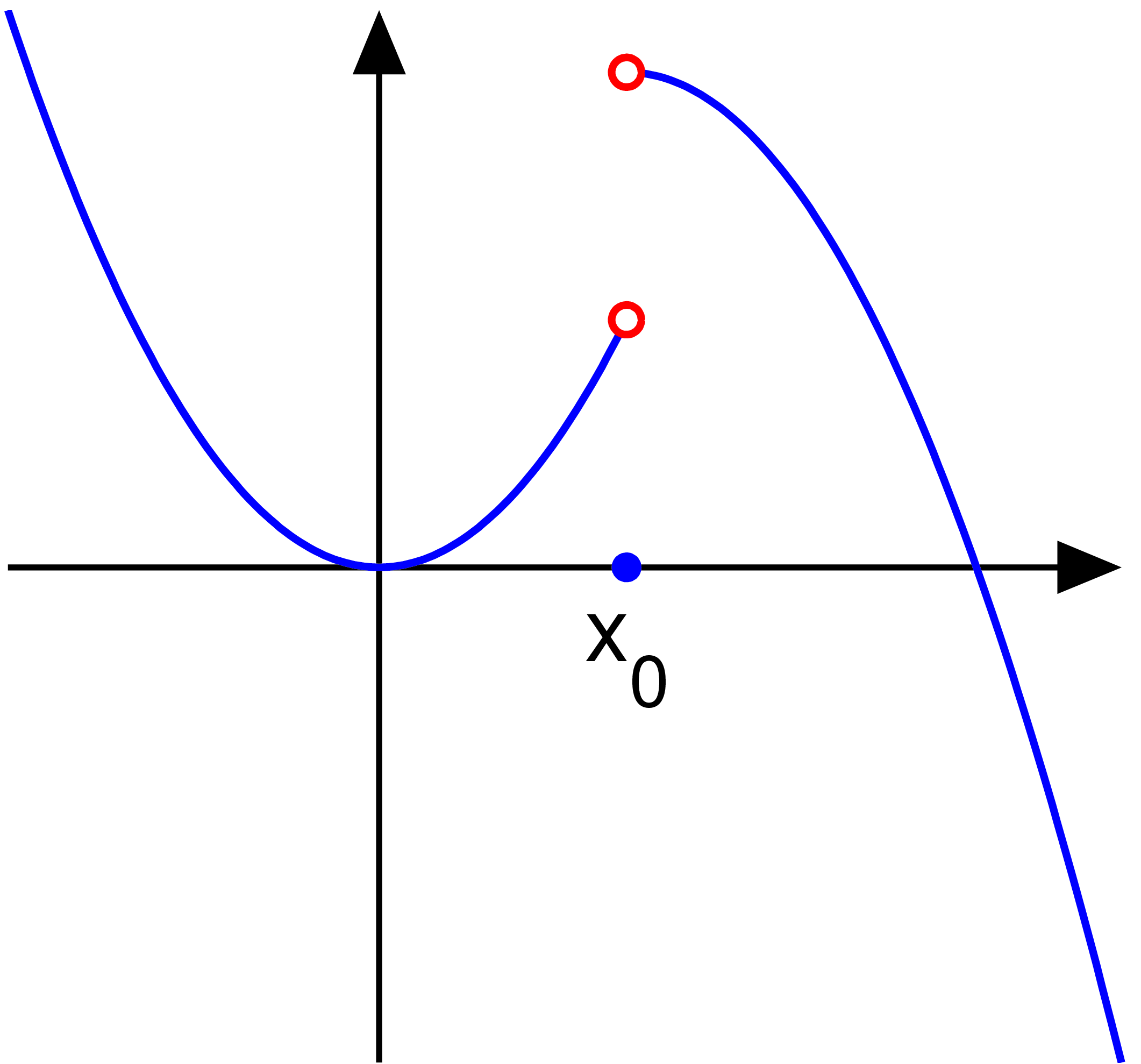
A) Jump Discontinuity
This means that they have different intended height from Left/Right when they are trying to reach the limit. This jump discontinuity has a limit that DOES NOT EXIST because it has a different intended height L/R.
http://upload.wikimedia.org/wikipedia/commons/e/e6/Discontinuity_jump.eps.png

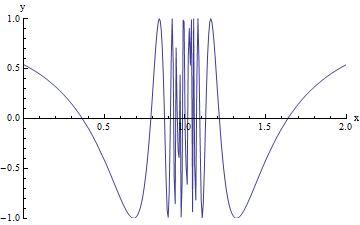
B)Oscillating Behavior
Another Non-Removable discontinuity, this can be described as a wiggly graph. This graph has a limit that DOES NOT EXIST because there is never a value or an intended height that is actually reached within the graph.
http://www.cwladis.com/math301/lecture%20images/infiniteoscillationdiscontinuityat1.gif

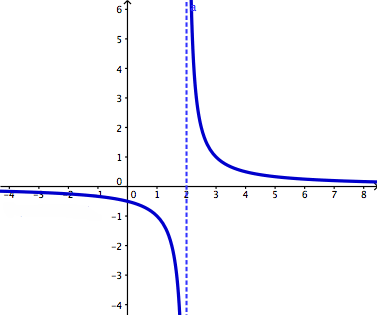
C)Unbounded/Infinite Discontinuity
We say it is unbounded because infinity is not a value that the graph ever reaches. There is usually a vertical asymptote which causes the unbounded behavior. The limit DOES NOT EXIST at unbounded/infinite graphs.
http://dj1hlxw0wr920.cloudfront.net/userfiles/wyzfiles/44bad38c-431e-4382-8fe9-86303561b2a0.gif

2. A limit is the intended height of a function. A limit exists when you have a continuous graph which means the value of the function is the same as the limit. A limit does not exist when the Non-Removable discontinuities and their restrictions appear on the graph. A limit is the intended height, whilst the value is the actual height (y-value).

3.We evaluate limits numerically by: evaluating it on a table. This means we take the number of 'asx--># and evaluate it on the graph from the left and right. We plug it in to the calculator and find the values that are closest to that # to find the actual value of the limit.
https://finitemathematics.wikispaces.hcpss.org/file/view/limit_table.PNG/239144381/575x194/limit_table.PNG

We evaluate limits graphically by: Observing the jumps, holes, values, continuities, breaks, and discontinuities. We observe where there are different restricitions and this determines whether the graph is continuous or discontinuous. We use there observations to find the value if there is a value and the limits if it is continuous.
http://curvebank.calstatela.edu/limit/imitscan.gif
 
We evaluate limits algebraically by: using 3 methods:
a)Direct Substitution- You take the # in the 'x->#' and plug it in directly into the function. You can get a numerical answer such as 0/#, #/0, and these are both possible answers. However, if you get 0/0 it is indeterminate form which means the answer is not yet determine and you have to use an alternative method.

b)Dividing/Factoring: Since direct substitution met a restriction when you got 0/0 (only use alternative methods when you get 0/0 from direct substitution) then you can factor both the numerator and denominator to cancel out common terms. This will remover the zero in the denominator. After you have canceled the terms, you plug in the 'x->' like in direct substitution to get your answer.

c)Rationalizing/Conjugate- This method also applies when you get 0/0 from direct substitution. If your equation has a radical, you multiply the denominator or numerator (depending which has the radical) by it conjugate. The part that didn't have the radical should not be multiplied out because the goal is to get terms to cancel out with the values that the conjugates give you. Then you can use direct substitution to find your final answer.

Tuesday, April 22, 2014

BQ#4: Unit T Concept 3

Tangent & Cotamgent:
A "normal" Tangent graph will go uphill because of the unit circle ratio: y/x. In Tangent's case, the x is what affects the placement of the graph and it's asymptotes. For a Cotangent graph, it also follows the unit circle ratio of x/y. However, for a Cotangent graph the y value affects the shifts of the graph causing it to to go downhill. The asymptote placement is the only factor that determines the direction of the graph. A normal tangent graph is uphill and a normal cotangent graph is downhill. The asymptotes for the graphs are in the same place, however cotangent has shifts.

Saturday, April 19, 2014

BQ#3: Unit T Concepts 1-3

A) Tangent
Tangent is related to sine and cosine graphs because of the identities from Unit Q, and because of tangents ratio. As we previously learned, Tan=sinx/cosx which means that an asymptote would appear when cosine is equal to 0. The ratio from the unit circle for tangent is y/x, which also applies if x equals 0 then it will be undefined and have asymptotes. Depending on the sign of each x and y value will determine the direction of the graph.

B) Cotangent
Cotangent is the reciprocal of tangent which makes it also related with sine and cosine except the ratio is x/y. In this case, when y is equal to 0 there will be asymptotes. The direction of the graph depends on the value of sine (x).

C) Secant
Secant is the reciprocal of cosine which makes if closely related to cosine. The ratio for secant is r/x. The sign of x is the determining factor for the asymptotes. We know the right sign for x when we do ASTC per the quadrants in the unit circle.

D)Cosecant
Cosecant is the reciprocal of sine which makes the ratio r/y. Since r is always equal to one, the determining factor for the asymptotes is the y value of the graph. The graphs never touch the asymptotes but they come very close just as in every other graph.

Friday, April 18, 2014

BQ#5: Unit T Concepts 1-3

Sine and cosine will never have asymptotes because they will never be undefined. Since their ratios are y/r and x/r with r being 1, there will never be an undefined answer regardless if the value of x or y in the ratio.  However, tangent, csc, sec, and cot can be undefined which means they can have asymptotes based on their ratios: y/x, r/x, r/y, and x/y. If for example we were given tan with y=7 and x=0, we would get an undefined answer.

Wednesday, April 16, 2014

BQ #2: Unit T Concept Intro

Trig graphs relate to the Unit Circle in the sense if ASTC, they have the same signs that each trig function has according to the Unit Circle. A period for sine and cosine is 2pi because it has to go around the entire thing to complete one period. It has to go around a whole time until it repeats it's pattern again. With a tangent and coltan gent graph, it only has to go half way around before it repeats it's pattern which makes it only pi. The biggest values for a sine and cosine graph is 1 or -1 which sets the boundaries for its amplitude. This is based off of the trig ratios for sine and cosine in the Unit Circle. The ratio for sine is y/r and for cosine it's x/r, with the value of r always equaling to 1.

Thursday, April 3, 2014

Reflection #1: Unit Q Verifying Trig Identities

1. When you are asked to verify a trig function that basically means that the terms you are given must in one form or another equal what is on the other side of the equal sign. Using identities to simplify the process with their substitution, you can get the identities to help you get alike terms on both sides of the equal sign to less complicate the verifying.
2. Some tips and tricks I have found helpful are taking a certain problem and splitting it into pieces rather than dealing with the whole problem at once. First I try to figure out if I have to substitute identities that will be similar throughout. If that doesn't seem to be an option then I multiply by the conjugate if I am given fractions. When all else fails I try the substituting identities and kind of play around with what I'm given until I get it to a simple enough route that I know I can solve.
3. When I first see a verifying trig problem I look at the terms given: sin,cos,tan,csc,cot,sec. Then I see if i have any identities that i can use as substitution for the problem. If I notice that the substitution of the identities complicates the number of steps to achieve the verifying then i retrace my steps and rethink my technique. Other options I have are probably dividing, adding, multiplying by the conjugate, or subtracting from one side to the other. I make sure to keep a close eye throughout my steps and make sure that there isn't an identity I can use whether it be a ratio, Pythagorean, or reciprocal. I don't have a very strategic technique other than trying different methods in order to make the verifying simpler. I have found that taking apart the problem helps visualize it clearer and allows you to focus on a particular situation instead of missing a step from dealing with the whole problem.

Wednesday, March 19, 2014

I/D #3: Unit Q Concept 1: Pythagorean Identites

INQUIRY ACTIVITY SUMMARY:
1. cos2x+sin2x=1 is derived from the unit circle. The pythagorean theorem is x^2+y^2=r^2. In the picture below I demonstrate how the pythagorean theorem relates to cos2x+sin2x=1, since the ratio for sine is y/r and for cosine its x/r we can also substitute that into the Pythagorean theorem and then divide everything by r2 to make it equal to one. This is another method for figuring out how cosine and sine are derived from the Pythagorean theorem.


2. We can also derive other forms of the equation sin2x+cos2x=1:

What I did in the first example is divided everything on both sides by sin2x. We then discovery that the division of sin2x leads to some ratio and reciprocal identities that change the equation to cotx and cscx. For step 3 I just substituted the identities into the equation. 
For the second example I started off by dividing by cos2x. This also resulted in a ratio and reciprocal identities. Last step I substituted the new identities into the equation.

INQUIRY ACTIVITY REFLECTION:
1.The connections I see between Unit N, O, P, and Q so far are that many different equations can be derived from the unit circle and they can be  right triangles or non right triangles.
2.If I had to describe trigonometry in three words, they would be Unit Circle, Triangles, and SOHCAHTOA.

Tuesday, March 18, 2014

WPP #12&13: Law of Sines and Cosines Applications

This WPP 13-14 was made in collaboration with Cynthia A.  Please visit the other awesome posts on their blog by going here
a)Michael and Harry are 4 miles apart when they see a stranded cat on a tree. Michael looks up N35E in the direction of the cat, Harry looks N51W at the cat. What is the height of the cat on the tree from the midpoint?


Solution:


b)Michael and Harry then head their own ways from the tree. By the time try leave it's 2pm. Michael is headed at 027 degrees and walking at the pace of 2.2 miles per hour. Harry is moving at the pace of 2.7 miles per hour at the bearing of 118 degrees. How far apart will they be by 4pm?


Sunday, March 16, 2014

BQ #1: Unit P Concept 2 Law of Sines & Concept 4 Area Formulas

2.Law of Sines
SSA is ambiguous because we can have one solution, two solutions, or no solution depending on the existing rules of Sines and triangles.

In this first case we have two solutions. This is possible in this type of problem because with the information given we were able to use the Sine of A to solve for the missing pieces. The first thing i did was solve for SinC which equaled to .1573 then took the inverse which gave us the value of the angle of C equal to 9. This problem did not meet any wall that would go against the laws of triangles or sines. It met the requirements of staying within 180 degrees and it Sine was not larger than 1. 

This case deals with one solution. The first thing I did was use Sine B as the main factor to solve for the missing pieces which in this case I solved for the Sine of A. After taking the inverse of SinA I got 8.1 as the angle of the first triangle, then i subtracted 8.1 from 180 to get the value of angle A for the second triangle and this is where I met a wall. Angle B has a value of 101 degrees, there can only be one obtuse angle within a triangle. When I added 101 to 171.9 it went over 180 degrees of a triangle so this meant there was only one solution.

Last example is no solution. This we automatically knew was not going to have any solutions because once we took the SinA it was bigger than one and sine cannot be bigger than 1. 


4.Area Formulas
The area of oblique triangles originated from the area formula of a triangle which is A=1/2bh. We derived it by for example in the triangle below:
http://www.compuhigh.com/demo/lesson07_files/oblique.gif
We took the sinC of triangle number 1 and made it equal to h/a also known as (O)pposite/(H)ypotenuse since were dealing with sine. Then we cross multiplied and got that h=asinC, this is the first part of the total equation now we know the value of h. Next we had to substitute the value of h into the original equation of area of a triangle. It related to the Area formula that I know because it doesnt matter what angle you use, the values will always be consistent. It just depends on the angle in which you are trying to find the area for.
https://blogger.googleusercontent.com/img/b/R29vZ2xl/AVvXsEjhMuKQl55_kU_UW-3B15iIKWQnm4jTq9kMH-dZjUZuvtX0xxXTAW8NgvHuSp-NNhckfbfuyplyEFb-r6krVc1zrdAOZMcVPI4lYEQN25jdRx-RL48qsF4Q0-o46Bs20KEofChd0GjczZk/s400/hi.bmp

Thursday, March 6, 2014

WPP#12: Unit O Concept 10: Solving angle of elevation and depression word problems

a)Michael measures from ground level the angle of elevation to the top floor of the concert stadium to be 14 degrees. If the base of the floor is 500 feet from the seats, how high are the top row seats?

b)Michael now stands up on the top floor of the concert stadium. He measures the angle of depression from the top floor to the base of the stage (10 feet above ground level) to be 16 degrees. He knows that he is now approximately 115 feet on the top of the top floor. How far are you horizontally from the stage?


http://31.media.tumblr.com/58dbe2cbb5f11655cbfb64d49415cc10/tumblr_mtb3d2e8lA1sqc3bro7_500.jpg


Solution:


Tuesday, March 4, 2014

I/D #2: Unit O Concept 7-8: Using the 30-60-90 and 45-45-90 Triangles

Inquiry Summary Activity:

To derive the Special Right Triangles from an equilateral triangle and a square, we had to arrange the values of each side to fit accordingly to the rules of the 30-60-90 and 45-45-90 triangles. The Pythagorean Theorem was used to change the value of the sides, when all sides were initially equal to 1.

1) 30-60-90 Triangle


First, I started off by labeling each side of the equilateral triangle 1. Next I cut the triangle down the middle, creating two 30-60-90 triangles. Next I labeled the 90 degree angle for each triangle. The 30 degree triangle is the top angle and the 60 degree angle are on the bottom ends. Next, I had to solve for the opposite side of the 60 degree angle. What we knew so far was that the hypotenuse (across from 90 degree angle) had a value of 1. The TOTAL value of the base of the triangle was equal to 1, after we cut it down the middle, it made each side of the bottom of the triangle equal to 1/2; so we knew the value of the opposite side of the 30 degree triangle was equal to 1/2. Now it was time to solve for the hypotenuse, so we use the Pythagorean Theorem. I set the missing side as a, then solved.

http://www.themathpage.com/aTrig/30-60-90-triangle.htm


In the Special 30-60-90 triangle rules, the value of the hypotenuse has to be equal to 2. So, this means since we got radical 3/2 for the side we solved for, we multiply all the sides of the triangles by 2. This will change out values to be: opposite to 90 degrees is 2, opposite to 60 degrees is radical 3, and opposite side to 30 degrees is equal to 1. Lastly, we add an n to the values of the 30-60-90 sides to help us solve for the missing side on the shared triangle. The variable allows us to solve for the "missing".


2)45-45-90 Triangle


After I labeled all sides of the square equal to 1, I cut the square diagonally through the middle. This created (2) 45 degree triangles. I labeled the 90 degree angle for each triangle to clearly see the 45 degrees on each triangle. The side opposite to the 90 degree angle is the hypotenuse. We don't know the value of the hypotenuse, we only have the value of the adjacent and opposite sides of the 45 degree angles; in order to figure out the hypotenuse value we have to use the Pythagorean Theorem.


http://www.getgeometry.com/images/45-45-90-triangle-ratios.png


Once we have used the Pythagorean Theorem, we get the hypotenuse to equal radical 2 for a 45-45-90 triangle. We then add the variable "n", so we have something to solve for. The purpose of the variable is so that we can solve for a missing side on the other triangle when the two are sharing a side; when we know all the sides to one triangle, it gives us the value of the shared side between the two so we can solve for the missing side on the second triangle.


Inquiry Activity Reflection:
1.Something I never noticed about special right triangles before is: that you can form a 30-60-90 or a 45-45-90 from shapes that don't seem to have triangles of this kind at first sight.
2.Being able to derive these patterns myself aids in my learning because: I can solve for any shape as long as I can derive special right triangles from them.

Saturday, February 22, 2014

I/D #1: Unit N Concept 7: Deriving the Unit Circle Activity

Inquiry Activity Summary:

In this activity, we dealt with Special right triangles: 30,60, 90  45,45,90  and 60, 30, 90:
http://ss.worldindustrialreporter.com/Library/ui/Trigonometry/Technical%20Shop%20Mathematics/Special%20Triangles%20and%20Unit%20Circle/1/default.aspx

The triangle's sides are labeled according to the Special Triangles Rule. The 30, 60, 90 triangle can also be known as: hypotenuse (2x) or (2 as labeled in the picture) opposite side to 30 degree angle as (x) or (1 as labeled) adjacent side as (x radical 3) or (radical 3 as labeled). The 45,45, 90 degree triangle has two sides that have the same value because there are two angles (45) that are the same. The 45,45,90 degree triangle can also be seen as: hypotenuse (x radical 2) or (radical 2) and the two 45 degree corresponding sides will both have the value of the side being (x) or (1).

1) 30 Degree:


The first triangle in the activity dealt with the 30 degree triangle. The first step was to get the hypotenuse to equal 1; the only way to make this possible was to divide ALL sides of the triangle by 2 and then simplify. This gave us the value of each side: HYPOTENUSE=1 ; OPPOSITE SIDE (to 30 degrees)= 1/2 ; ADJACENT SIDE (to 30 degrees)= radical 3/2. Next, I labeled the hypotenuse (r), the horizontal value (x), and the vertical value (y). The next step was to draw the triangle on a coordinate plane. The triangle must lie in quadrant I which means that the origin of the triangle is angle 30, making its ordered pair value (0,0). When we move over the the 90 degree angle, we move a distance of (radical 3/2, 0), then we move up to our 60 degree angle and x distance of radical 3/2 and up distance(vertical) of 1/2 giving us the ordered pair (radical 3/2, 1/2) *notice that these ordered pairs correspond to the side value after we simplified all sides to make the hypotenuse equal to one*

2) 45 Degree


In a 45 degree triangle, the hypotenuse is radical 2 (r), horizontal side is x (x), and the vertical side is x (y). The value of the hypotenuse has to equal to 1 so I had to divide everything by radical 2. This made r=1, x=radical 2/2, y=radical 2/2. Next i drew the coordinate plane for the 45 degree triangle and its origin (45 degrees) was (0,0), 90 degree was (radical 2/2,0), and the last side point was (radical 2/2, radical 2/2). Any other angle with a reference angle of 60, will have the same values throughout the unit circle(signs vary depending on quadrant).

3) 60 Degree


Last but not least, we have the 60 degree triangle. The hypotenuse(r) is 2, opposite (to 60 degrees) is radical 3, and adjacent (to 60 degrees) is x. Since the hypotenuse has to equal 1, I divided everything by 2, this made r=1, (y/ vertical)= radical 3/2, and (x/horizontal)= 1/2. After drawing the triangle on a coordinate plane, it is in Quadrant I. The ordered pairs for the triangle are: (0,0), (1/2, 0), and (1/2, radical 3/2). In ANY angle with a reference angle of 60, the values will be the same.

4)This activity helps us derive the unit circle because once we find the values for the 30, 60, and 45 degree triangles in the first quadrant, we can figure out the rest of the unit circle.


5)The triangle drawn in this activity lies in Quadrant I. This means that ALL values are positive. The values change depending on the restrictions of each quadrant. As seen above, in Quadrant II the x value turns negative in all ordered pairs. In Quadrant III the x AND y value are negative for all ordered pairs. In Quadrant IV, the y value is negative in all ordered pairs.

INQUIRY ACTIVITY REFLECTION:
1. The coolest thing I learned from this activity was that once you figure out all the parts to triangles with 60, 30, and 45 degrees, they basically set you up for the rest of the unit circle.
2.This activity will help me in the unit because it will help me memorize the ordered points and the reference angles to which they correspond to.
3.Something I never realized before about special right triangles and the unit circle is how they existed within each other and how they can help you with any angle as long as you find the reference angle.

Tuesday, February 11, 2014

RWA: Unit M Concept 4: Parabola


http://mathworld.wolfram.com/Parabola.html


1. A parabola is the set of all points the same direction from a point (vertex) and the line (directix).
2. The equation consists of only one term being squared. Depending on the squared term (x or y) and the +/or - value of p determines the direction that the parabola. The squared term is on one side and the constant and the other term is on the other side. The parabola can look like a wide U or a narrow U. It can go up, down,left, or right. It can be fat or skinny and this depends on the location of the Focus. The focus point is located inside the parabola.
The distance from the vertex to the directrix is equal to p distance from the focus to ANY point on the parabola straight down to the directrix is always the same (SSS Packet). If the x is squared the axis of symmetry is vertical. If the y is squared then the axis of symmetry is horizontal. P tells how far away the focus and directrix are from the vertex.
The eccentricity of a parabola is 1. The distance between the directrix increases, then the parabola widens. The parabola can appear as wide or narrow. (http://www.mathwarehouse.com/geometry/parabola/)
 3.
The formation in which the dolphin leaps from the ocean forms a parabola. The dolphin's distance from the ocean is the focus.

REFERENCES
http://mathworld.wolfram.com/Parabola.html
http://www.schooltube.com/video/3079ad71ed4640288123/2.1%20Overview%20of%20Parabolas
http://www.mathwarehouse.com/geometry/parabola/
http://www.google.com/imgres?q=real%20world%20parabola&safe=active&client=firefox-a&hs=mJO&sa=X&rls=org.mozilla%3Aen-US%3Aofficial&tbm=isch&tbnid=lFhJ_8_GvfaulM%3A&imgrefurl=http%3A%2F%2Fbritton.disted.camosun.bc.ca%2Fjbconics.htm&docid=bZKYayFU5KYxCM&imgurl=http%3A%2F%2Fbritton.disted.camosun.bc.ca%2Fparaporpoise_lg.GIF&w=640&h=361&ei=y7D6UsnIFIngqQHPtIBA&zoom=1&ved=0CHgQhBwwDA&iact=rc&dur=252&page=1&start=0&ndsp=20&surl=1