Pages

Thursday, June 5, 2014

BQ#7: Unit V Difference Quotient

The difference quotient is used to find the line of a tangent graph.  We see a secant line when the curve is touched by a secant line on two points. In contrast, the tangent line only touches the curve at one particular point. A tangent line can be horizontal along the curve. The different points on the curve have different values these values are not numerical but they are substituted by [x+h, f(x+h)], [x, f(x))], and these are the coordinates which allow us to derive the difference quotient. We can say delta x instead of h because it basically means the same thing. It just depends on the units you are using to solve for the graph.


http://cis.stvincent.edu/carlsond/ma109/DifferenceQuotient_images/IMG0470.JPG
http://sites.csn.edu/istewart/mathweb/math126/diff_quotient/images/fun5_d2.GIF


Monday, May 19, 2014

BQ#6: Unit U Concepts 1-8

1. Continuity is a predictable graph that goes where you think it should. These graphs have no breaks, holes, or jumps. You can draw continuity graphs without lifting your pencil because they are, continuous. The value and the limit are the same.
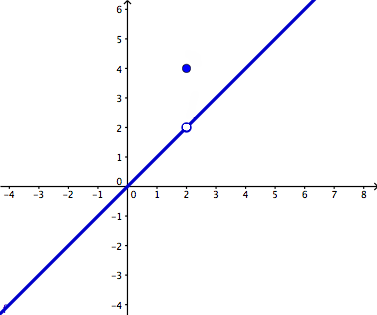
Discontinuity consists of two families: Removable discontinuities and Non-Removable discontinuities. They are separated into two families because the non-removable does not have existing limits, while the removable does. The removable discontinuity has one possibility: point discontinuity.
http://dj1hlxw0wr920.cloudfront.net/userfiles/wyzfiles/4a69dec7-03e0-492f-ac16-4dcd555579c9.gif

This point discontinuity has a hole but there is no value at the hole. The value exists only if there is a closed circle above or below it.

The Non-Removable discontinuities consists of 3 types of discontinuities.
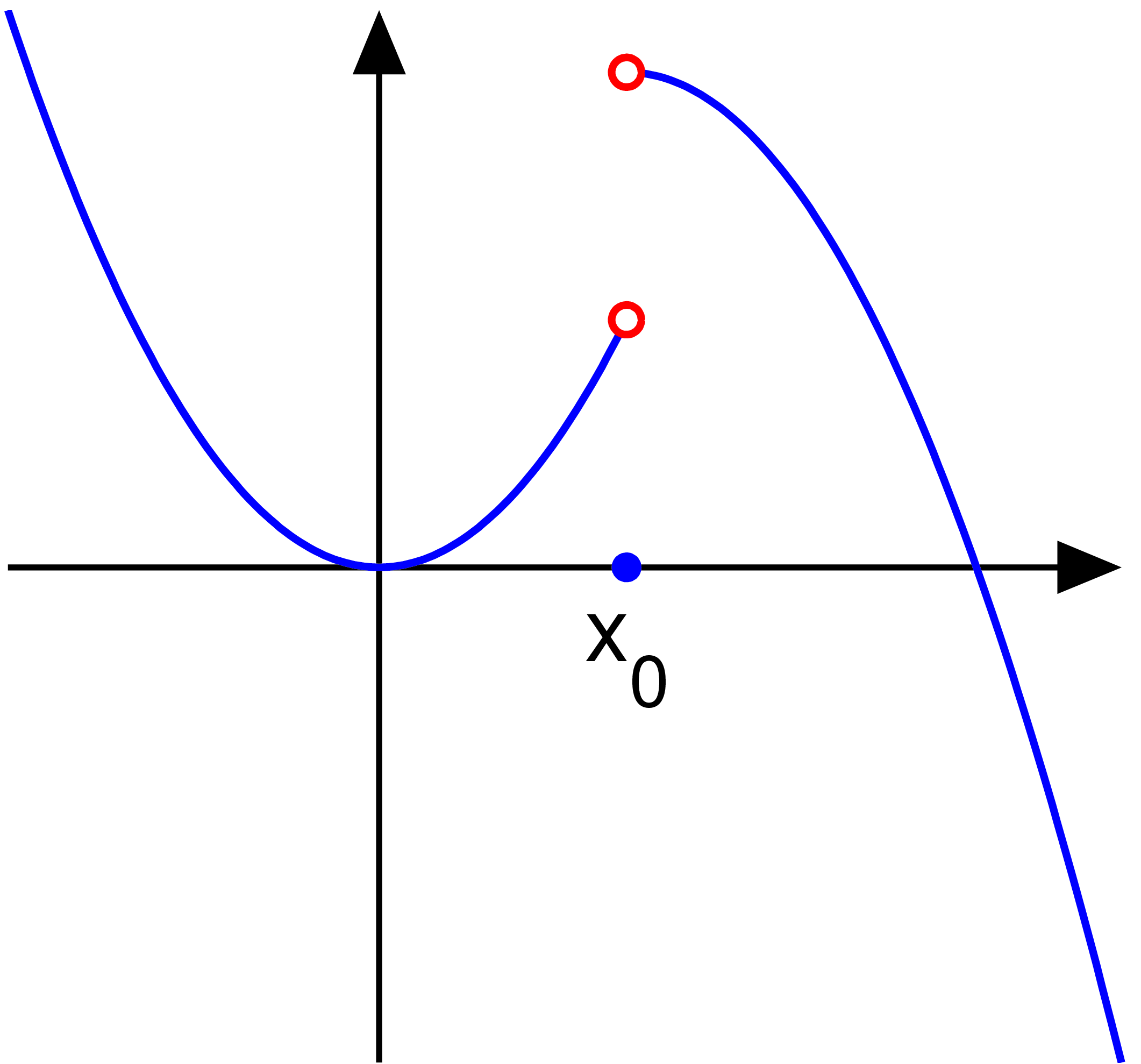
A) Jump Discontinuity
This means that they have different intended height from Left/Right when they are trying to reach the limit. This jump discontinuity has a limit that DOES NOT EXIST because it has a different intended height L/R.
http://upload.wikimedia.org/wikipedia/commons/e/e6/Discontinuity_jump.eps.png

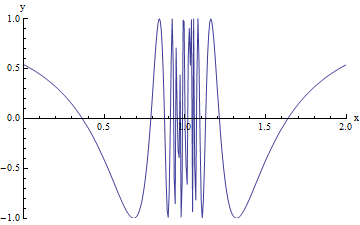
B)Oscillating Behavior
Another Non-Removable discontinuity, this can be described as a wiggly graph. This graph has a limit that DOES NOT EXIST because there is never a value or an intended height that is actually reached within the graph.
http://www.cwladis.com/math301/lecture%20images/infiniteoscillationdiscontinuityat1.gif

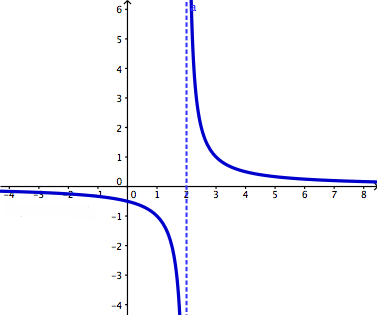
C)Unbounded/Infinite Discontinuity
We say it is unbounded because infinity is not a value that the graph ever reaches. There is usually a vertical asymptote which causes the unbounded behavior. The limit DOES NOT EXIST at unbounded/infinite graphs.
http://dj1hlxw0wr920.cloudfront.net/userfiles/wyzfiles/44bad38c-431e-4382-8fe9-86303561b2a0.gif

2. A limit is the intended height of a function. A limit exists when you have a continuous graph which means the value of the function is the same as the limit. A limit does not exist when the Non-Removable discontinuities and their restrictions appear on the graph. A limit is the intended height, whilst the value is the actual height (y-value).

3.We evaluate limits numerically by: evaluating it on a table. This means we take the number of 'asx--># and evaluate it on the graph from the left and right. We plug it in to the calculator and find the values that are closest to that # to find the actual value of the limit.
https://finitemathematics.wikispaces.hcpss.org/file/view/limit_table.PNG/239144381/575x194/limit_table.PNG

We evaluate limits graphically by: Observing the jumps, holes, values, continuities, breaks, and discontinuities. We observe where there are different restricitions and this determines whether the graph is continuous or discontinuous. We use there observations to find the value if there is a value and the limits if it is continuous.
http://curvebank.calstatela.edu/limit/imitscan.gif
 
We evaluate limits algebraically by: using 3 methods:
a)Direct Substitution- You take the # in the 'x->#' and plug it in directly into the function. You can get a numerical answer such as 0/#, #/0, and these are both possible answers. However, if you get 0/0 it is indeterminate form which means the answer is not yet determine and you have to use an alternative method.

b)Dividing/Factoring: Since direct substitution met a restriction when you got 0/0 (only use alternative methods when you get 0/0 from direct substitution) then you can factor both the numerator and denominator to cancel out common terms. This will remover the zero in the denominator. After you have canceled the terms, you plug in the 'x->' like in direct substitution to get your answer.

c)Rationalizing/Conjugate- This method also applies when you get 0/0 from direct substitution. If your equation has a radical, you multiply the denominator or numerator (depending which has the radical) by it conjugate. The part that didn't have the radical should not be multiplied out because the goal is to get terms to cancel out with the values that the conjugates give you. Then you can use direct substitution to find your final answer.

Tuesday, April 22, 2014

BQ#4: Unit T Concept 3

Tangent & Cotamgent:
A "normal" Tangent graph will go uphill because of the unit circle ratio: y/x. In Tangent's case, the x is what affects the placement of the graph and it's asymptotes. For a Cotangent graph, it also follows the unit circle ratio of x/y. However, for a Cotangent graph the y value affects the shifts of the graph causing it to to go downhill. The asymptote placement is the only factor that determines the direction of the graph. A normal tangent graph is uphill and a normal cotangent graph is downhill. The asymptotes for the graphs are in the same place, however cotangent has shifts.

Saturday, April 19, 2014

BQ#3: Unit T Concepts 1-3

A) Tangent
Tangent is related to sine and cosine graphs because of the identities from Unit Q, and because of tangents ratio. As we previously learned, Tan=sinx/cosx which means that an asymptote would appear when cosine is equal to 0. The ratio from the unit circle for tangent is y/x, which also applies if x equals 0 then it will be undefined and have asymptotes. Depending on the sign of each x and y value will determine the direction of the graph.

B) Cotangent
Cotangent is the reciprocal of tangent which makes it also related with sine and cosine except the ratio is x/y. In this case, when y is equal to 0 there will be asymptotes. The direction of the graph depends on the value of sine (x).

C) Secant
Secant is the reciprocal of cosine which makes if closely related to cosine. The ratio for secant is r/x. The sign of x is the determining factor for the asymptotes. We know the right sign for x when we do ASTC per the quadrants in the unit circle.

D)Cosecant
Cosecant is the reciprocal of sine which makes the ratio r/y. Since r is always equal to one, the determining factor for the asymptotes is the y value of the graph. The graphs never touch the asymptotes but they come very close just as in every other graph.

Friday, April 18, 2014

BQ#5: Unit T Concepts 1-3

Sine and cosine will never have asymptotes because they will never be undefined. Since their ratios are y/r and x/r with r being 1, there will never be an undefined answer regardless if the value of x or y in the ratio.  However, tangent, csc, sec, and cot can be undefined which means they can have asymptotes based on their ratios: y/x, r/x, r/y, and x/y. If for example we were given tan with y=7 and x=0, we would get an undefined answer.

Wednesday, April 16, 2014

BQ #2: Unit T Concept Intro

Trig graphs relate to the Unit Circle in the sense if ASTC, they have the same signs that each trig function has according to the Unit Circle. A period for sine and cosine is 2pi because it has to go around the entire thing to complete one period. It has to go around a whole time until it repeats it's pattern again. With a tangent and coltan gent graph, it only has to go half way around before it repeats it's pattern which makes it only pi. The biggest values for a sine and cosine graph is 1 or -1 which sets the boundaries for its amplitude. This is based off of the trig ratios for sine and cosine in the Unit Circle. The ratio for sine is y/r and for cosine it's x/r, with the value of r always equaling to 1.

Thursday, April 3, 2014

Reflection #1: Unit Q Verifying Trig Identities

1. When you are asked to verify a trig function that basically means that the terms you are given must in one form or another equal what is on the other side of the equal sign. Using identities to simplify the process with their substitution, you can get the identities to help you get alike terms on both sides of the equal sign to less complicate the verifying.
2. Some tips and tricks I have found helpful are taking a certain problem and splitting it into pieces rather than dealing with the whole problem at once. First I try to figure out if I have to substitute identities that will be similar throughout. If that doesn't seem to be an option then I multiply by the conjugate if I am given fractions. When all else fails I try the substituting identities and kind of play around with what I'm given until I get it to a simple enough route that I know I can solve.
3. When I first see a verifying trig problem I look at the terms given: sin,cos,tan,csc,cot,sec. Then I see if i have any identities that i can use as substitution for the problem. If I notice that the substitution of the identities complicates the number of steps to achieve the verifying then i retrace my steps and rethink my technique. Other options I have are probably dividing, adding, multiplying by the conjugate, or subtracting from one side to the other. I make sure to keep a close eye throughout my steps and make sure that there isn't an identity I can use whether it be a ratio, Pythagorean, or reciprocal. I don't have a very strategic technique other than trying different methods in order to make the verifying simpler. I have found that taking apart the problem helps visualize it clearer and allows you to focus on a particular situation instead of missing a step from dealing with the whole problem.